Published with Blogger-droid v1.3.5
Monday, 21 June 2010

Tuesday, 1 June 2010
Design for Distribution - Evaluation after thoughts
Having a few days to think further about what has happened over the course of the last module has allowed me to dig up a few more issues..
The problem in all reality was something I tried to address right at the beginning of this project with my choice of briefs. I chose several that were based around branding, packaging and promoting, as well as one or two that specifically asked for motion graphics. I wanted to combine the two - I wanted to brand a TV channel or Radio station, and then come up with the motion graphics based around what I designed. In the first crits, or discussions as they were really, I was rightly told that I was perhaps taking on too much and if motion graphics was what I wanted to do then I should focus on that. I left that crit feeling incredibly confused.
Looking back it's obvious now that the problem with the whole of this brief is that I couldn't see where design fitted in. If the brief was the Asian Beers one, I would have set about the design process as I have done in the past with relative ease. Designing the rebrand, the logo, the packaging, all the while thinking how the designs can be made move and applied to a televised campaign as part of the distribution.
By picking a specifically motion graphics brief I couldn't get my head round how to start the project. How can I story board when I have no initial designs and ideas generation? I completely forgot how to put together a logical and thorough design process all because the brief had the words motion graphics in it.
In my head, to do a motion graphics brief, motion graphics had to be the main focus of everything I did. Where as - in reality - it's always going to be secondary to the design process.
This continuous cycle of not being able to do the motion graphics because I haven't designed enough, and not being able to design because I have to do motion graphics, is what has destroyed what could have been a really good brief.
Now I've realised this is an issue, it should be pretty easy to fix over summer...
The summer months are going to be spent working out how to answer a brief that specifically calls for motion graphics, and how I can set up a process of designing that works for me.
I'm going to try some really quick turn around projects - and document the process more than anything else to figure out the bits that work and the bits that don't work.
The problem in all reality was something I tried to address right at the beginning of this project with my choice of briefs. I chose several that were based around branding, packaging and promoting, as well as one or two that specifically asked for motion graphics. I wanted to combine the two - I wanted to brand a TV channel or Radio station, and then come up with the motion graphics based around what I designed. In the first crits, or discussions as they were really, I was rightly told that I was perhaps taking on too much and if motion graphics was what I wanted to do then I should focus on that. I left that crit feeling incredibly confused.
Looking back it's obvious now that the problem with the whole of this brief is that I couldn't see where design fitted in. If the brief was the Asian Beers one, I would have set about the design process as I have done in the past with relative ease. Designing the rebrand, the logo, the packaging, all the while thinking how the designs can be made move and applied to a televised campaign as part of the distribution.
By picking a specifically motion graphics brief I couldn't get my head round how to start the project. How can I story board when I have no initial designs and ideas generation? I completely forgot how to put together a logical and thorough design process all because the brief had the words motion graphics in it.
In my head, to do a motion graphics brief, motion graphics had to be the main focus of everything I did. Where as - in reality - it's always going to be secondary to the design process.
This continuous cycle of not being able to do the motion graphics because I haven't designed enough, and not being able to design because I have to do motion graphics, is what has destroyed what could have been a really good brief.
Now I've realised this is an issue, it should be pretty easy to fix over summer...
The summer months are going to be spent working out how to answer a brief that specifically calls for motion graphics, and how I can set up a process of designing that works for me.
I'm going to try some really quick turn around projects - and document the process more than anything else to figure out the bits that work and the bits that don't work.
Friday, 28 May 2010
Design for Distribution - Evaluation
Though part of a larger module overall, this section of the Design Practice module has been a bit of a roller coaster, as these things usually are for me, however, I'm not sure I like where I have ended up. The Collaborative brief ended quite strangely, and though over all I was happy with the result, I didn't feel I was well prepared for the weeks to follow. This all became evident within the first few days, when as a class we were posed some pretty difficult questions. Everyone had their own way of dealing with them, some were extremely confident - I wasn't one of those. To have to think in such detail about where I saw myself in industry really terrified me, especially as I knew we were coming to the end of the year - a typically stressful period at the best of times.
This significantly stunted my progress with the brief at hand, and after a week or so of panic, I began to get to grips with this new idea of writing our own briefs. It took me a long time, too long, to figure out what it was I wanted to get out of this project. The answers were simple really, but again I fell into a trap of trying to predict the outcome of every decision before it is made. This is a massive issue for me. I fear making the wrong decision and so am constantly second guessing myself - I guess this is evident throughout the year. Thinking back to the digital module, the personal issues I was having made it impossible to worry about the work, I just did it and got a great deal out of it - including my best grade yet. So it seems the more opportunity I give myself to worry and over think a project, the more I'll do it.
After this very slow start I finally pinned down what I wanted to achieve. The main one was to get into After Effects as soon as possible and start to really gain an understanding of the software. This in itself confused me as to how I would go about making sure I produced a project that was suitable to submit. I became very aware through the project that I was cutting out huge parts of the development process, lacking a strong concept and generally ignoring everything I'd learnt so far. It soon became a conscious decision - I have proven that I can deliver a project with a solid concept, I can story board and develop ideas in new and interesting ways, and I feel that the goals I had set myself in this module would have greatly suffered had I set out to do the same again. I was also aware that working with motion graphics always takes longer than I anticipate, again reinforcing my decision to limit the amount of actual design development.
Towards the end of this project is where I started to really let myself slip. Lots of the worries from earlier in the project came back, and looking back I can now see that was because I hadn't documented the early stages of the project thoroughly enough, and so the initial decisions I had made - I simply forgot. I also know, and was told many times that I just needed to get on with things, stop thinking and start doing. I think a lot of my failings towards the end of this project can be explained by a simple lack of motivation. The question is then - how can I address this in future? I think the answer to this lies within the briefs I pick in future. As the rest of the course is going to be self directed, I need to really think about the kind of brief I want to answer, I think the most important thing is to make it fun. I need to pick briefs that are fun, or can be made fun, about topics that I personally find interesting and that allow me to progress, rather than stand still. In a sense I'm happy that I had such a hard time with this project, as it's made me realise what I need in a brief, and what I definitely do not need!
To answer the all important question though, the reason I wanted to go down this path of developing technical skills - Do I want to continue with motion graphics? Yes. Definitely. I did not achieve as much as I wanted to with this module, even within After Effects like I wanted to, but it's only left me wanting to do more. I think that's a clear sign that this is what I want to do. Now I just need to make sure that this decision doesn't make me close doors for myself in other areas, motion graphics will be something that evolves and develops with me through my design practice - it's not the be all and end all of everything I do.
Things to address over summer.
- Identify the kind of brief that I want to answer in future - keep it fun.
- Spend time actually being creative with the software I want to develop in - without the stress of a deadline.
- Do things that remind me why I love what I do, have some fun!
- See this as an opportunity to do some of the things I've always wanted to!
- Get some more contacts within industry, take a few day trips to studios and find out exactly how and where motion graphics fits into the world.
- Figure out a way to deal with the stress and workload.
- This is my last opportunity to figure out a way of working that doesn't lead to excess stress and an inability to deal with things - I need to really utilise it.
- Do not neglect my blog.
- I want to do so much over the summer, and I see this as a great opportunity to get into a better blogging routine. Even just 10 minutes every night would solve nearly all of my problems, and help me organise what I need to do the next day. A project diary and daily action plan combined.
To summarise, I have made a bit of a mess of the past few weeks. I think this is to do with my own worrying, making me think instead of act. It's a pretty vicious circle, and I need to be able to recognise when this is happening and take steps to rectify it in future.
Design for Distribution - Project File
The act of keeping a project file in itself has been massively beneficial in that it has simply made me feel more organised. All those bits of paper that get lost and end up unread are all in one place and in the right order. Definately one to remember.
I feel my over all time management and organisational skills have really improved since easter.
I feel my over all time management and organisational skills have really improved since easter.
Thursday, 27 May 2010
Design for Distribution - Website
The website is a difficult one to explain - without it being live.


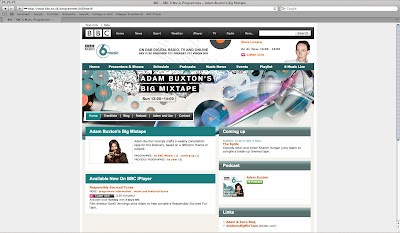


Basically, the website shows who is on air at any time during the day, so the splash page, or home page of the site changes depending on this. Each presenter has there own identity that is in-keeping with Radio 6's current branding, and the individual design is interwoven with what already exists.
BEFORE
AFTER - Adam Buxton

AFTER - Marc Riley


As you navigate through the website, each presenter's identity is applied to his or hers own page.
ADAM BUXTON
BEFORE
AFTER

MARC RILEY
BEFORE

AFTER

Design for Distribution - Final Videos
So here's the final videos for this submission. I've mixed feelings about them.
On the one hand, I really enjoyed the process of working with stop frame, and rotoscope for that matter. Though both of them look really amateur, I never set out to achieve anything more than that. It was all about the process and the technical ability. I now feel that I can use these techniques to achieve something far more advanced as I have a good knowledge of the foundations of both processes.
On the other hand, I didn't really push the boundaries as far as the overall visuals of the pieces. Pretty standard vector overalys and masks make up the rest of the videos - I slipped back into my comfort zone here I think. As I had used camera moves to make up the basis of the stop frame and rotoscope, I discounted the possibility of another camera in After Effects. I cannot believe I overlooked this opportunity, as working with cameras in the software was an aspect I really enjoyed in the digital module.
I really love how the animated logo turned out. It was the part I spent the most time working with, and I think I achieved a really nice effect. Part of the enjoyment I get from motion graphics is people asking me "How did you do that?" - I got asked that several times with regard to the logo - which is usually a good indicator that I've done something a bit different and interesting.
Anyway, here's the videos. More effort went in than meets the eye, I promise.
FINAL ROTOSCOPE - MARC RILEY
FINAL STOP FRAME - ADAM BUXTON
On the one hand, I really enjoyed the process of working with stop frame, and rotoscope for that matter. Though both of them look really amateur, I never set out to achieve anything more than that. It was all about the process and the technical ability. I now feel that I can use these techniques to achieve something far more advanced as I have a good knowledge of the foundations of both processes.
On the other hand, I didn't really push the boundaries as far as the overall visuals of the pieces. Pretty standard vector overalys and masks make up the rest of the videos - I slipped back into my comfort zone here I think. As I had used camera moves to make up the basis of the stop frame and rotoscope, I discounted the possibility of another camera in After Effects. I cannot believe I overlooked this opportunity, as working with cameras in the software was an aspect I really enjoyed in the digital module.
I really love how the animated logo turned out. It was the part I spent the most time working with, and I think I achieved a really nice effect. Part of the enjoyment I get from motion graphics is people asking me "How did you do that?" - I got asked that several times with regard to the logo - which is usually a good indicator that I've done something a bit different and interesting.
Anyway, here's the videos. More effort went in than meets the eye, I promise.
FINAL ROTOSCOPE - MARC RILEY
FINAL STOP FRAME - ADAM BUXTON
Wednesday, 26 May 2010

Subscribe to:
Posts (Atom)